In greenhouse production, climate is not a background variable, it is a core production input.
Temperature, humidity, and air movement directly influence crop health, uniformity, and yield.
At the same time, energy efficiency has become essential for growers to maintain profitability while achieving optimal climate conditions.
Many climate issues in greenhouses are not caused by lack of technology, but by incorrect system design or operation.
Below are five of the most common greenhouse climate control improvements that can significantly enhance performance and crop results.
1. Using air circulators as part of the cooling system
During pad-fan cooling operation, air circulators are sometimes kept running together with exhaust fans.
However, this is unnecessary: the pad-fan system already generates strong longitudinal airflow due to the negative pressure created by the fans.
Air circulators play a different and crucial role in greenhouses:
- during winter and mid-season when ventilation is mainly natural (roof or side vents)
- during heating periods to eliminate hot and cold spots
- to maintain gentle air movement on the crop canopy
- to reduce dew formation on leaves
Properly used, air circulation improves climate uniformity and plant health, but it should not be considered part of evaporative cooling
2. Underestimating air distribution inside the greenhouse
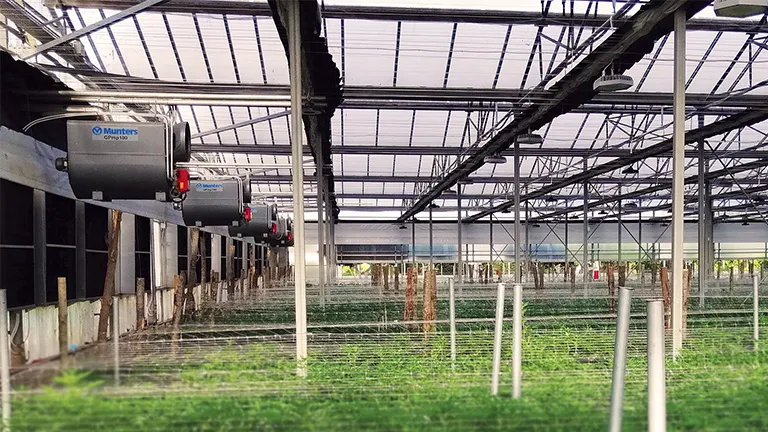
Even with high-quality equipment, poor distribution can compromise climate performance.
Two common issues are frequently observed:
Too few heaters with high output
Installing a small number of large heaters may reduce initial cost, but it often creates uneven temperature distribution.
A higher number of smaller heaters distributed across the greenhouse (for example, one per bay) ensures:
- better heat uniformity
- fewer hot/cold zones
- improved crop consistency
Incorrect number or size of air circulators
Insufficient air movement across the canopy increases the risk of condensation, disease pressure, and uneven growth.
Air circulation requirements vary by crop type, greenhouse geometry, and climate strategy, making proper sizing essential.
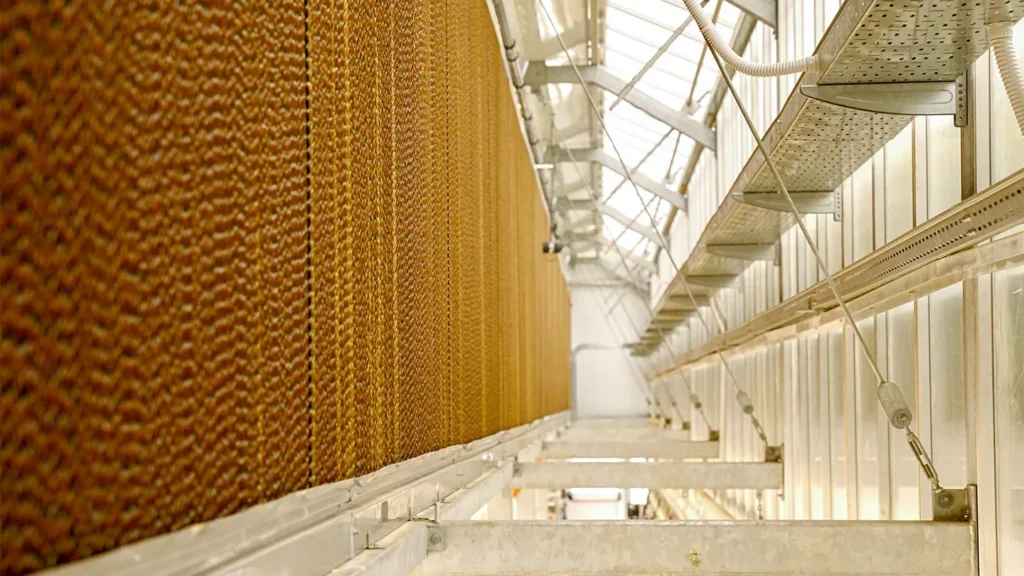
3. Selecting the wrong cooling pad for the climate and crop
Cooling pad selection must consider both regional climate and crop physiology.
In hot and dry regions, high-efficiency pads help maximize temperature reduction without excessive humidity increase.
In milder or already humid climates, the same pad type may lead to excessive greenhouse humidity, negatively affecting crop health.
Crop sensitivity to humidity also varies:
- some crops tolerate high relative humidity
- others require drier conditions
Correct pad selection therefore requires balancing cooling capacity, humidity impact, and crop requirements.
4. Designing for average climate instead of real extremes
Many greenhouse climate systems are sized using average weather data.
But crops are affected by extremes, not averages. Heat waves, high humidity periods, and seasonal transitions often reveal system limitations.
Climate solutions should therefore be designed to perform under real operating conditions, including peak loads and extreme scenarios. Systems engineered for extremes provide:
- higher climate reliability
- better crop protection
- more stable production
- lower operational risk
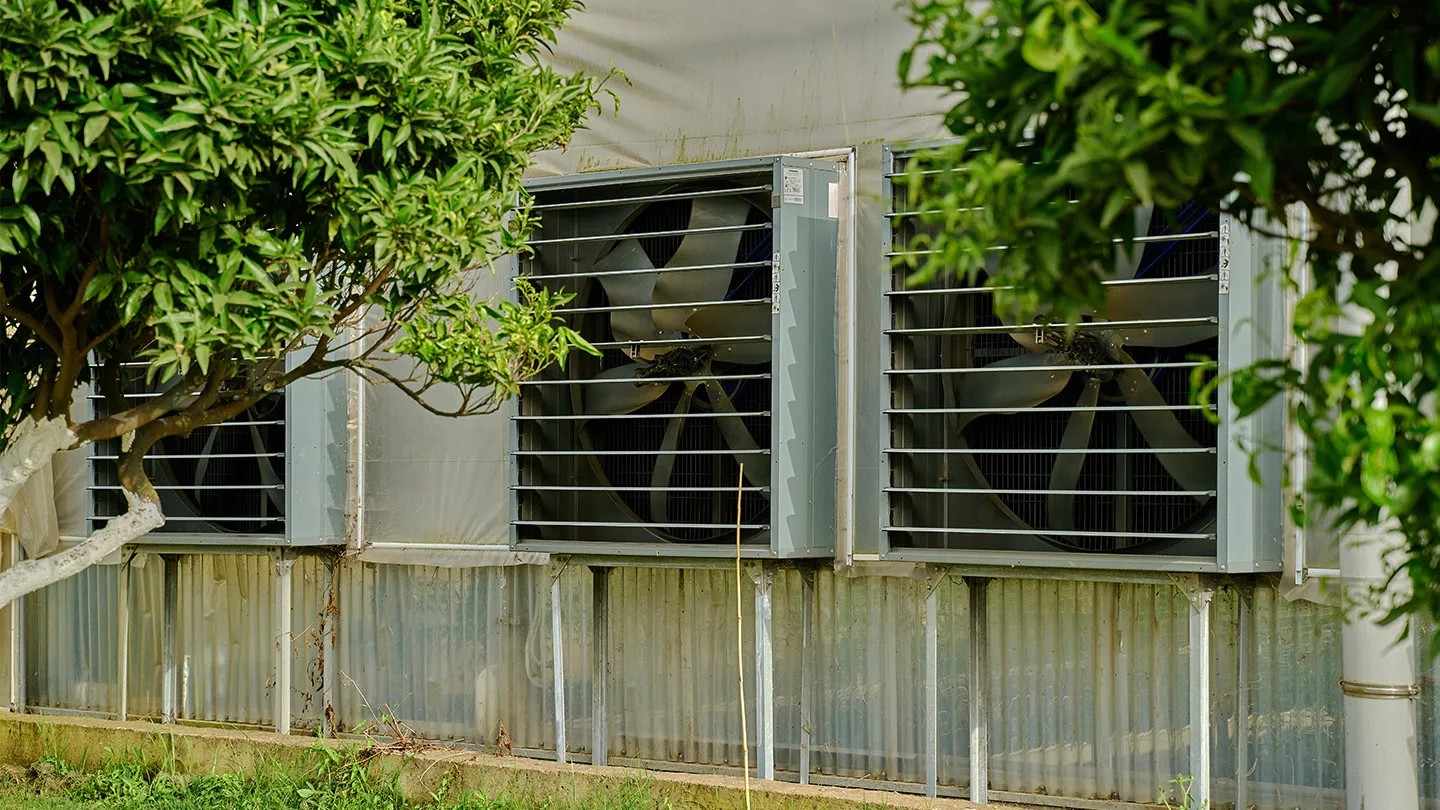
5. Incorrect positioning of exhaust fans in pad-fan systems
Research from Wageningen University & Research shows that, in pad-fan greenhouses, exhaust fans should be installed as high as possible. Warm air naturally stratifies in the upper greenhouse zone.
High-level fan placement therefore removes the hottest air first, improving cooling effectiveness and reducing evaporative water consumption.
Experimental trials in a Saudi Arabian greenhouse demonstrated:
- 14% higher fresh weight productionover 40% water savings in evaporative cooling
- These results highlight how correct fan positioning can significantly improve both crop yield and resource efficiency.
Conclusion
Greenhouse climate performance depends not only on equipment quality, but on correct system design, sizing, and operation.
By addressing these five frequently overlooked improvements, growers can achieve:
- more uniform climate conditions
- healthier crops
- improved yields
- higher energy and water efficiency
Optimizing climate control is not about adding more technology, it is about using the right solutions in the right way.
Ultimately, effective climate control should be treated as a long-term production strategy, not simply a set of technical components.
Greenhouse performance improves when growers approach climate as an integrated system influencing crop health, resource efficiency, and operational stability.
The most successful growers:
- think in systems, not just products
- focus on correct installation and layout, not only equipment specifications
- collaborate with climate specialists to design the entire greenhouse environment, rather than selecting equipment based only on price